Hexapods by Symétrie
Symétrie designs and manufactures high-performance hexapod systems for precision positioning, motion simulation and demanding test applications. From sub-micron alignment platforms to multi-tonne motion systems, their 6-DOF solutions combine accuracy, stiffness and flexibility across aerospace, defence, research, optics and advanced industrial applications.
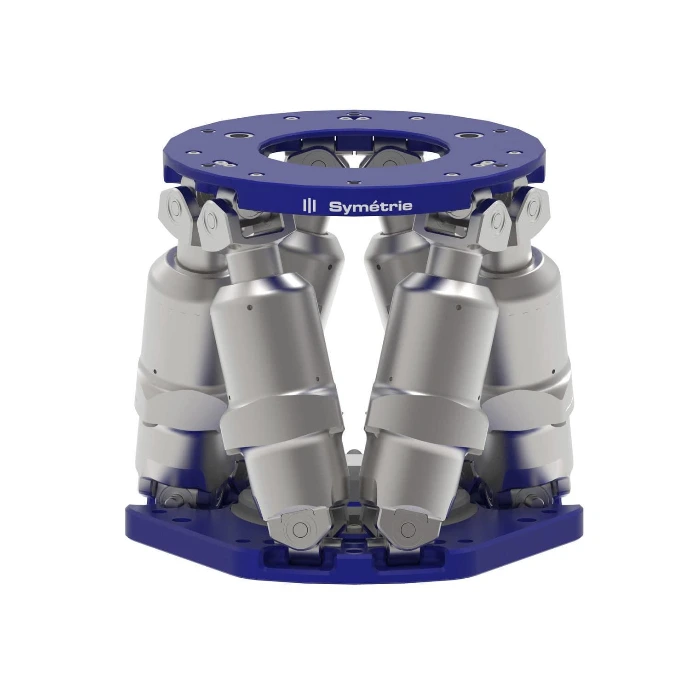
Precision Positioning Hexapods
Symétrie precision positioning hexapods provide six degrees of freedom in a compact parallel-kinematic platform, allowing extremely accurate translation and rotation of components in X, Y, Z, Rx, Ry and Rz. The range extends from compact 5 kg platforms through to systems capable of positioning loads up to 1,500 kg, with linear resolution down to 0.1 µm on many models.
Their combination of precision, stiffness and repeatability makes them particularly well suited to optics, photonics, metrology, synchrotrons, astronomy, semiconductor equipment and advanced research applications where conventional stacked linear and rotary axes can become difficult to integrate.
Motion Simulation Hexapods
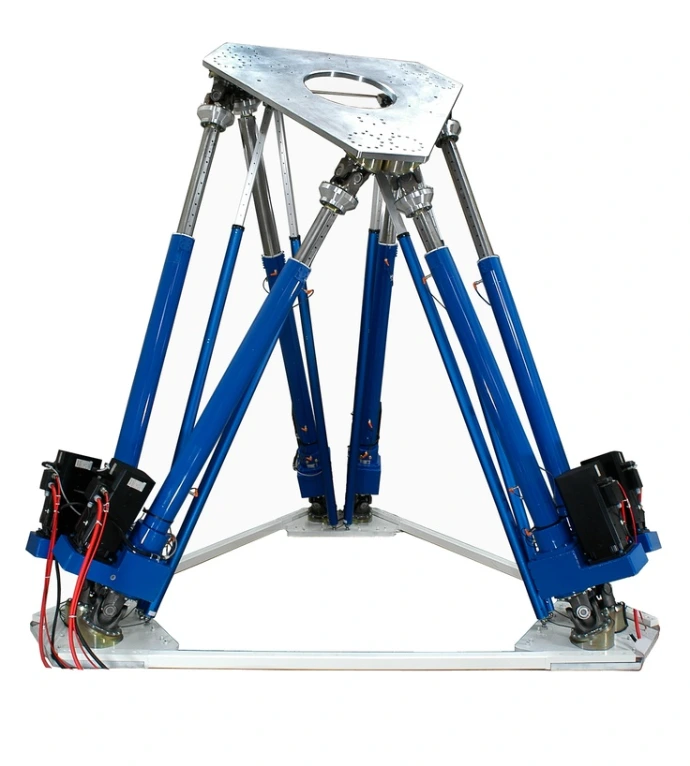
Symétrie motion hexapods are designed for applications where the objective is not simply to reach a precise position, but to accurately reproduce dynamic movement. The range covers compact platforms for laboratory and sensor testing through to large systems capable of moving several tonnes at high speed across all six degrees of freedom.
Motion profiles can be used to reproduce the behaviour of aircraft, ground vehicles, ships and other moving platforms, making these systems ideal for inertial sensor testing, electro-optical systems, SATCOM antennas, hardware-in-the-loop testing, vehicle simulation and research. High acceleration, wide travel and rigid parallel kinematics provide repeatable motion under demanding dynamic loads.
High-Payload Hexapods
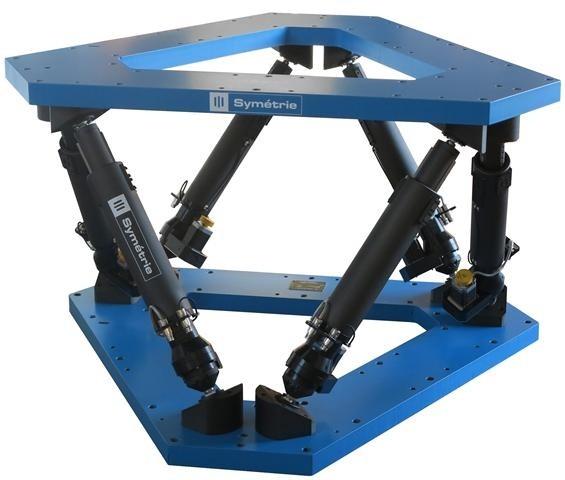
Moving a large payload precisely across six axes presents a very different challenge to conventional positioning. Symétrie high-payload hexapods combine a rigid parallel architecture with precision control to position or dynamically move loads ranging from hundreds of kilograms through to several tonnes. Positioning systems are available for loads up to 1,500 kg, while large motion platforms extend into multi-tonne capacities for demanding test and simulation applications.
These platforms are particularly suited to aerospace structures, satellite and space hardware, large optical assemblies, antennas, energy research and other applications where heavy equipment must be aligned, calibrated or moved without sacrificing repeatability, stiffness or control.
Special Environment Hexapods
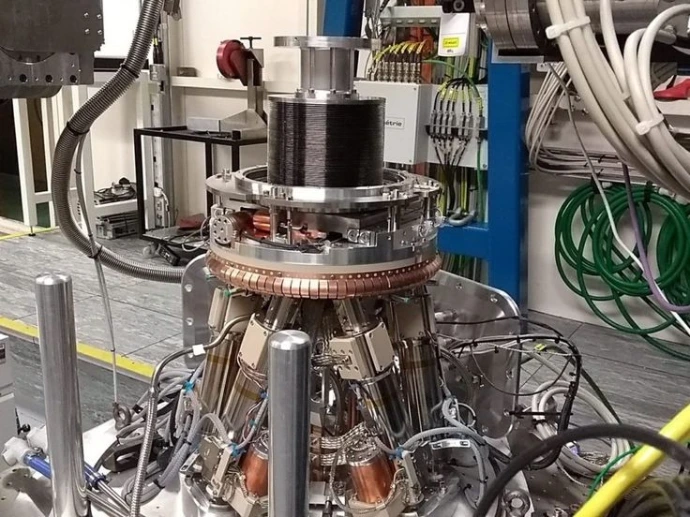
Precision motion often needs to operate well outside normal laboratory conditions. Symétrie hexapods can be configured for demanding environments including high vacuum down to 10⁻⁶ mbar, ISO Class 5 cleanrooms, outdoor operation, low-temperature applications and non-magnetic environments. Specialised materials, lubricants, motors, sensors and mechanical treatments are selected to maintain positioning performance while meeting the environmental requirements of the application.
These configurations make Symétrie platforms particularly suitable for space simulation, semiconductor equipment, telescope and optical systems, scientific instrumentation and outdoor sensor testing, where contamination, atmospheric conditions, temperature or magnetic interference can make a standard motion platform unsuitable.
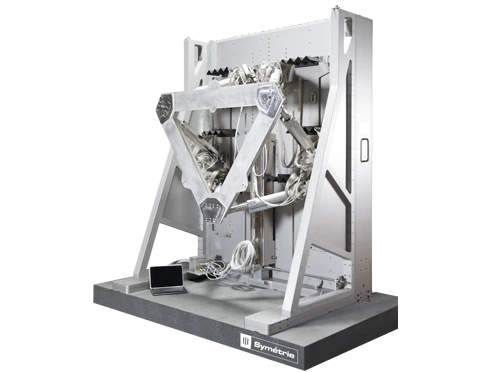
Custom Hexapod Systems
Not every six-axis application fits within a standard platform. Symétrie develops customised hexapods and complete multi-axis systems around the specific payload, travel, speed, accuracy, geometry and environmental requirements of an application. Customisation can range from modifications to an existing platform through to the development of a completely new hexapod or integrated test system.
Symétrie’s engineering capability covers mechanical design, kinematics, motorisation, control, calibration and software, allowing the complete system to be developed around the application rather than forcing the application around an existing product. This approach is particularly valuable for aerospace, defence, research and industrial projects with unusual geometry or performance requirements.